I am finding it hard to believe that it is already the middle of August! The summer always flies by, but it seems like it is even more so this year.
I have been working on the first step of my initial plan, which is a literature review. I am no stranger to finding a great deal of articles on a subject; after all, I help Masters students conduct literature searches regularly. I make the same joke often to students–as I email them the PDF file with a list of 10-20 sources that “now you get to do the fun part!”, and they laugh because they are polite and will put up with a bad joke from a librarian who just helped them figure out how to find articles properly. But now I actually get to do the “fun part,” aka actually reading articles instead of just finding them, and I find myself liking it!
I have a folder in Zotero that I’ve been sorting through as I read articles and make my notes. This is the first time that I’ve used Zotero for a proper research project of my own* and I love it as much as I expected I would, and maybe even more. Right now, my favourite feature that is new to me is that if I highlight text on a PDF in the app then copy and paste it into Word (or anywhere!), it will format the copied text as a quotation with an in-text citation. This is super useful for my style of note-taking as I can copy and paste ideas around different documents without worrying that I will end up accidentally quoting an article without attributing it properly. (Like, where was this when I was writing twenty papers a semester??)
I’ve read about 30 articles (with varying thoroughness) at this point, and I’ve started sorting my notes and highlighted passages into themes. Right now, those themes are:
- Barriers and Challenges [to doing EDI work]
- Benefits [of EDI work]
- Definitions [of EDI and related terms]
- Frameworks [and lists of concepts that I want to come back to]
- Libraries are great [librarians know this one. Vocational awe and things like “libraries are the BEST place on campus EVER to do EDI work]
- Research methods and evaluation [these are combined cause I only could only fit 8 documents open on my monitor at once before going bonkers. Research methods are things that I want to come back to for surveys or website analysis later, and evaluation covers assessment of EDI work]
- Ideas for EDI work
- Disagreements [this is my favourite category. It includes ideas that different articles had that contradict each other. I’m not sure how much it will come into play with my project overall but I’m having fun with it]
Some of these are vague at this point, but I have ideas about what I want to say based on the themes and what I’ve learned from my reading and pondering so far.
The current step I’m at is sorting through the Ideas for EDI Work document and further sorting these notes into sub-categories. Many articles have listed categories that EDI work tends to fall into in libraries (for example, common categories are collections work, hiring for diversity, and student outreach), and I am going to use those as a starting place and sort this document accordingly. My hope is that this will support the literature review by demonstrating common activities that libraries across these articles have done to support EDI, but it will also serve as a starting point for the final document that I promised in my sabbatical proposal, an EDI Action Plan [Proposal] for the TRU Library. Of course, I am not intending to stroll back onto campus next year and start telling everyone what to do when it comes to EDI. Rather, I am envisioning at least part of this plan taking the form of a menu to show what other institutions have done that we could do as well.
Finally, the next step is to start thinking about what the website scan is going to look like. The purpose of the website scan is to look at other academic libraries in BC (and maybe other places in Canada) to see what their EDI looks like according to their library website and publicly available information. I have an outline of what to look for on websites (I’m calling this my rubric”, but I think I will need to look at a few websites as I’m creating the rubric to make sure I’m not missing anything. I’m also starting to suspect based on everything I’ve read and a few websites I’ve glanced at that a lot of EDI work is invisible, and maybe I will not get as much out of the website scan as I was initially hoping for. However, there is only one way to find out!
Summary:
- Recently completed: gathering and reading articles
- Currently working on: sorting notes, drawing connections
- Next: finalize website scan rubric and plan
* My other uses of Zotero have been (a) random examples for workshops, (b) collecting resources for reports like “how many articles did TRU authors publish this year?” and (c) collections of articles that I think I’ll read someday for professional development purposes.
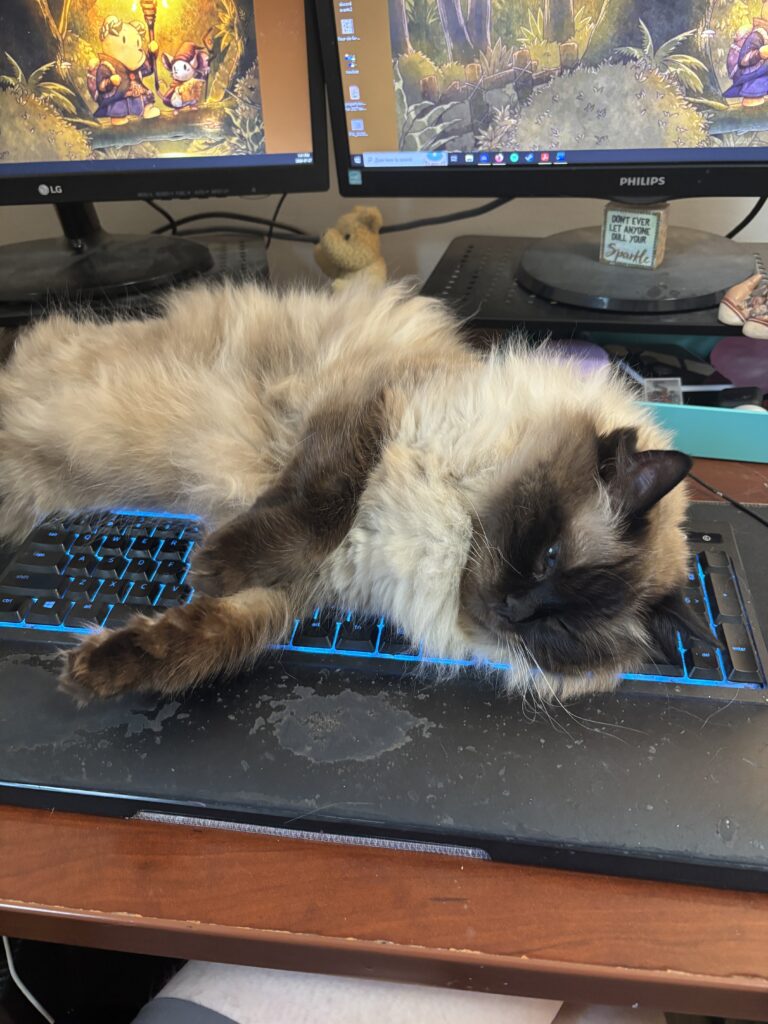
Cat Tax